
Safety Sensor Alignment: Why Your Industrial Garage Door Won’t Close and Engineering Solutions
In cold chain logistics, the thermal envelope is the single most important factor in operational profitability. Every minute an industrial door remains stuck open due to a technical malfunction, the facility suffers from a massive “energy hemorrhage.” For facility managers, a door that refuses to close is not merely a mechanical annoyance; it is a direct drain on refrigeration budgets and a risk to product integrity. Safety sensor alignment (photoelectric eyes) is often the silent culprit behind these closing failures. Understanding how to troubleshoot and realign these sensors is essential for maintaining both facility security and energy ROI.
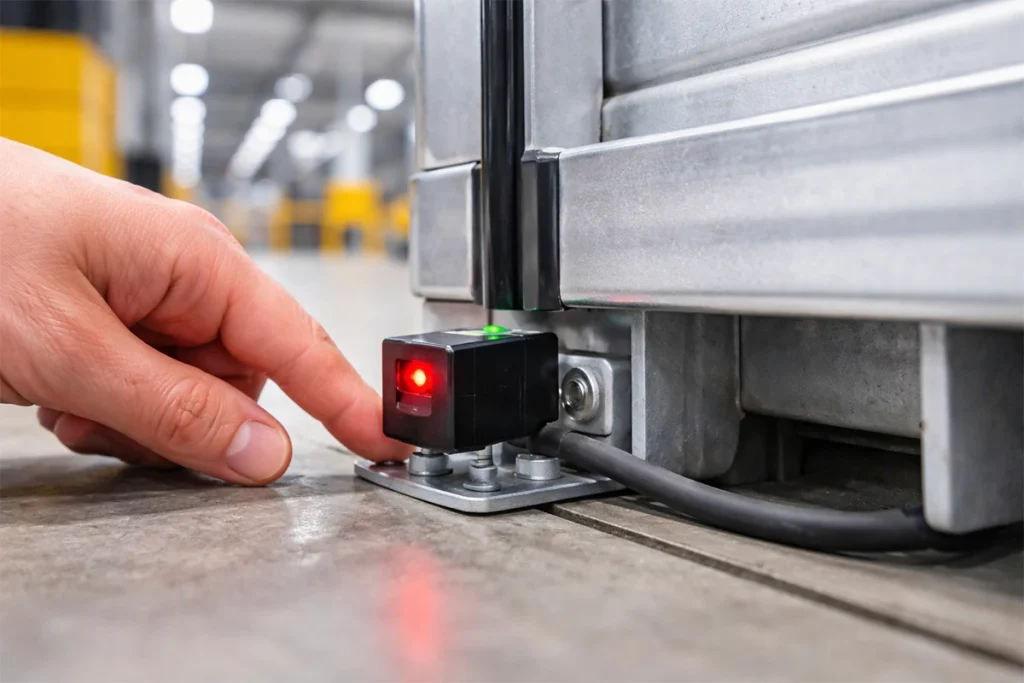
Troubleshooting Safety Sensor Alignment: The Silent ROI Killer
Industrial safety sensors utilize an invisible infrared beam to detect obstructions in the door path. If the beam is interrupted or the sensors become misaligned, the system’s logic prevents the door from closing to avoid impact.
Environmental Interference
In high-traffic logistics hubs, vibration from forklifts or structural shifts can nudge sensor brackets out of position.
Debris and Contamination
In food processing or pharmaceutical warehouses, dust and moisture buildup on the lens can simulate an obstruction, keeping the door in a permanent “open” state and allowing expensive treated air to escape.
Technical Comparison: High-Speed Precision vs. Standard Systems
Addressing closing failures requires an analysis of the door system itself. The following table illustrates why upgrading to high-speed automation reduces the risks associated with sensor-related downtime.
Operational Performance Matrix
Feature | Standard Sectional Door | ABX High-Speed Spiral Door |
Opening/Closing Speed | 0.2 m/s (Slow cycle) | 1.5 – 2.5 m/s (Rapid cycle) |
Safety Sensor Type | Basic Photo-eyes | Multi-path Light Curtains |
Vibration Resistance | Low (Sensitive to alignment) | High (Robust industrial housing) |
Thermal Loss Prevention | Poor when stuck open | Exceptional (Self-diagnostic logic) |
Ideal Application | Secondary bays | High-traffic Cold Storage |
How to Realign Garage Door Sensors: A Technical Protocol
When an industrial door fails to close, facility leads should follow this rigorous protocol to restore the thermal barrier:
Lens Inspection : Clean both the sending and receiving lenses with a soft cloth. Dirt or frost is often misinterpreted as an object in the doorway.
LED Status Verification : Observe the indicator lights. A flickering or dark LED usually indicates that safety sensor alignment has been compromised.
Bracket Adjustment : Gently loosen the wing nuts and adjust the sensor until the LED glows steadily. Tighten the hardware to ensure resistance against future industrial vibrations.
Expert Tip: U-Value and Perimeter Integrity
Realigning the sensors is only the first step. If your door closes but the U-value (thermal transmittance) is high due to worn EPDM perimeter seals, you are still bleeding profit. During your sensor check, always inspect the seal compression. A truly efficient facility balances sensor reliability with an airtight thermal envelope to minimize energy OpEx.
Strategizing for Long-Term Reliability
Investing in smart garage door automation with self-diagnostic safety features is the ultimate risk mitigation strategy. ABX high-speed systems utilize full-height light curtains instead of single-point photo-eyes. This technology provides a wider sensing field, making the system far less susceptible to the micro-misalignments that plague standard doors.
By selecting ABX Doors, you leverage 15 years of engineering authority. We provide the technical transparency and industrial-grade hardware required to ensure your facility remains secure, efficient, and thermally optimized.
Request a technical datasheet or CAD specification from our engineering team today.