
Hydraulic vs. Mechanical Dock Levelers: A Comprehensive Selection Guide for Facility Managers
Thermal leakage during loading and unloading cycles represents the most severe financial hemorrhage in cold chain logistics. For facility managers overseeing temperature-controlled warehouses, every second the loading bay is compromised means massive energy loss, overworked HVAC systems, and potential cargo spoilage. Securing this thermal envelope starts with the floor—specifically, the dock leveler—and extends to the entryway system above it. As logistics hubs upgrade for efficiency, the debate between hydraulic vs. mechanical dock levelers has shifted from a question of initial budget to a strategic analysis of long-term ROI, safety, and thermal integrity.
The Core Mechanisms: Hydraulic vs. Mechanical
To make an informed procurement decision, one must understand the operational physics behind these two industrial staples.
Mechanical Dock Levelers
Mechanical levelers operate using an upward-biased spring mechanism. Operators must pull a chain to release the hold-down, allowing the springs to raise the deck. The operator then physically walks the deck down onto the truck bed.
Pros: Lower initial acquisition cost; no electrical power required.
Cons: High maintenance due to spring fatigue; increased ergonomic strain on operators.
Hydraulic Dock Levelers
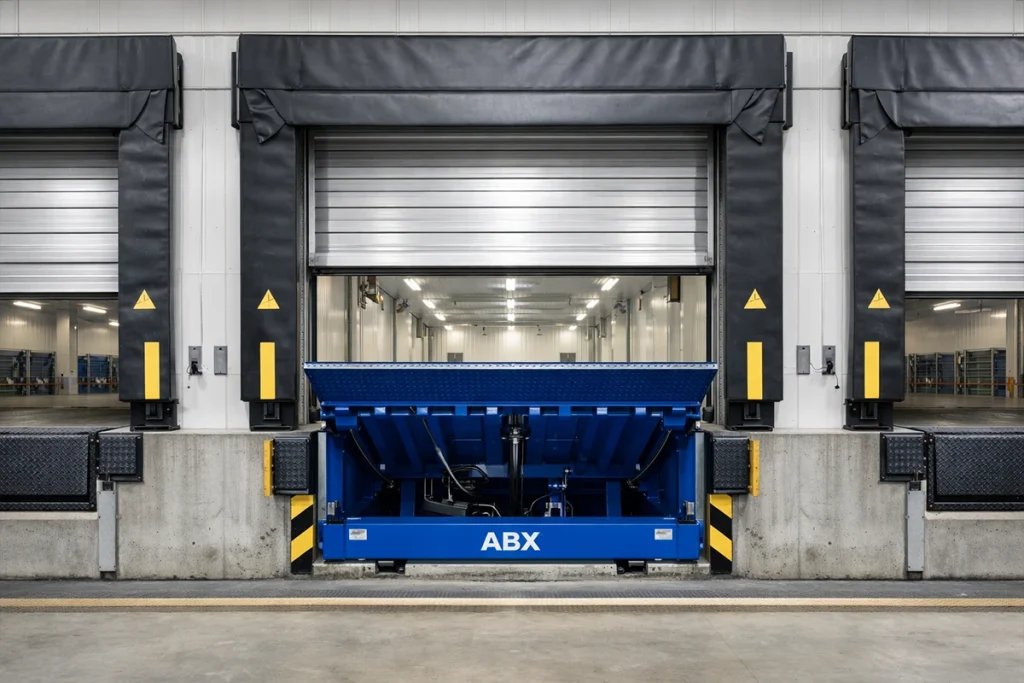
Hydraulic levelers utilize fluid-powered cylinders driven by an electric motor. Operation requires a simple push of a button on a control panel, automating the entire raising and lip-extension process.
Pros: Zero ergonomic strain; minimal maintenance (fewer moving parts); highest safety integration.
Cons: Higher initial capital investment; requires a dedicated electrical source.
Securing the Thermal Envelope: The Loading Dock Ecosystem
A dock leveler does not operate in isolation. In cold chain facilities, the leveler and the garage door must work in synergy. Even the most advanced hydraulic leveler will bleed energy if paired with a slow, poorly insulated door. Facility managers must look at the complete “entryway ecosystem.”
Performance Matrix: Standard vs. High-Speed Loading Bay Doors
Feature | Standard Sectional Door | ABX High-Speed Spiral Door |
Cycle Speed | 0.2 m/s (approx. 45s per cycle) | 1.5 – 2.5 m/s (under 5s per cycle) |
Thermal Loss/Cycle | High (Long exposure to ambient air) | Minimal (Instantaneous closure) |
Interlock Capacity | Basic / Manual | Seamless integration with Hydraulic Leveler |
Ideal Environment | Low-traffic ambient warehouses | High-traffic cold chain / Pharma |
Note: ABX smart control boxes allow the hydraulic leveler and high-speed door to interlock—preventing the door from opening until the leveler is safely engaged, maximizing both safety and energy conservation.
Expert Tip: The Supremacy of U-Value at the Dock
It is a common misconception to evaluate dock energy efficiency by the R-value of the door panel alone. The critical metric is the U-value (thermal transmittance) of the entire installed system. A loading bay with gaps around the leveler pit and standard perimeter seals creates “air bypass.” Always specify ABX Hydraulic Levelers with under-deck foam insulation and weather-seal brush strips, paired with EPDM-sealed doors, to achieve the lowest possible U-value.
Operational Safety and Long-Term ROI
While mechanical levelers offer a budget-friendly entry point, hydraulic systems dominate the Total Cost of Ownership (TCO) calculation for professional facilities.
Safety Velocity Fuses : ABX hydraulic levelers feature built-in velocity fuses. If a truck pulls away prematurely, the hydraulic system instantly locks the deck, preventing a forklift free-fall—a safety feature mechanical levelers cannot effectively match.
Maintenance Downtime : Mechanical springs fatigue and require regular adjustment and eventual replacement. Hydraulic fluid systems require only routine inspection, ensuring 24/7 uptime for aggressive logistics schedules.
Strategic Procurement for Modern Logistics
Choosing between hydraulic and mechanical dock levelers defines the operational tempo of your facility. For high-volume distribution centers, particularly in the cold chain, the synergy of a hydraulic leveler and a high-speed industrial door is an engineering necessity. It protects your personnel, accelerates your throughput, and decisively cuts the operational expenses associated with thermal leakage.
Request a technical datasheet or CAD specification from our engineering team today.