
How to Properly Lubricate Your Garage Door: A Step-by-Step Maintenance Guide for Industrial ROI
Thermal leakage in cold chain logistics represents an invisible drain on corporate profitability. For facility managers, a garage door is not just a moving barrier; it is a critical component of the thermal envelope. When an industrial door lacks proper lubrication, increased mechanical friction leads to sluggish cycle speeds and improper seating against perimeter seals. This resulting “energy hemorrhage” spikes refrigeration costs and compromises the safety of temperature-sensitive inventory. At ABX Doors, we prioritize preventative maintenance as a strategic tool to ensure your facility maintains its competitive edge through operational efficiency.
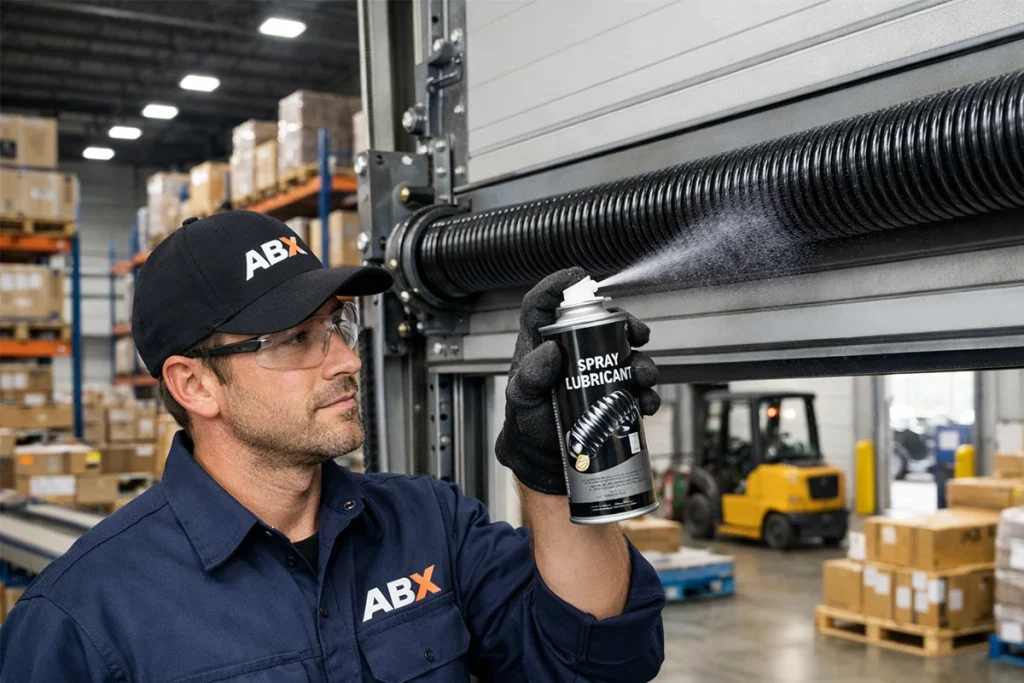
Engineering the Smooth Cycle: The Science of Industrial Lubrication
In high-traffic distribution centers, a door may cycle hundreds of times per day. Without a professional garage door maintenance schedule, metal-on-metal friction generates heat and premature component fatigue.
Torsion Springs
These components handle immense tension. Lubricating them prevents rust and the “chattering” sound that signals impending failure.
Rollers and Tracks
Use high-performance silicone or lithium-based sprays. Avoid standard grease, as it attracts industrial dust, creating an abrasive paste that grinds down the bearing raceways.
Speed as a Metric of Energy Conservation
The choice between a standard sectional door and a high-speed system often dictates your long-term energy ROI. Maintenance ensures that these systems operate at their peak designed velocity.
Performance Comparison: Standard vs. High-Speed Systems
Feature | Standard Sectional Door | ABX High-Speed Spiral Door |
Typical Speed | 0.2 m/s (approx. 45s per cycle) | 1.5 – 2.5 m/s (under 5s per cycle) |
Cycle Frequency | Low to Moderate | High (24/7 Operations) |
Heat Loss per Cycle | High (Extended air exchange) | Minimal (Rapid Seal) |
Lubrication Need | Quarterly | Biannual (Sealed Bearings) |
Step-by-Step Lubrication Protocol for Facility Leads
Following a rigorous protocol ensures that maintenance downtime is minimized while maximizing the lifespan of the hardware.
Cleaning the Tracks : Before applying any lubricant, use a clean rag to remove debris and old residue from the track’s interior.
Spring Saturation : Spray the entire length of the torsion springs until they are saturated but not dripping. This reduces internal friction between the coils.
Bearing and Hinge Points : Focus on the pivot points of each hinge and the bearing housing of each roller.
Expert Tip: The Criticality of the U-Value and Seal Integrity
Lubrication is only half the battle. If your door is perfectly lubricated but has a poor U-value (thermal transmittance), you are still losing money. Always inspect the EPDM perimeter seals for cracks or gaps during your maintenance cycle. A low U-value achieved through airtight sealing is the foundation of energy ROI. Mechanical precision must support thermal performance.
Strategizing for Long-Term Structural Security
Investing in high-quality automation and a disciplined maintenance schedule is a risk mitigation strategy. Sluggish doors lead to forklift collisions, unplanned downtime, and supply chain disruptions.
By selecting ABX Doors, you leverage 15 years of engineering authority. Our systems are designed for high-cycle environments, utilizing low-maintenance components that simplify your facility’s OpEx management. Aligning your infrastructure with professional standards ensures that your facility remains not just operational, but profitable.
Request a technical datasheet or CAD specification from our engineering team today.