
When to Repair vs. Replace Your Industrial Door: A Strategic Cost-Benefit Analysis
Thermal leakage at loading bays is a silent drain on corporate profitability. For facility managers in cold chain logistics, an inefficient entryway represents more than a maintenance ticket—it is a primary driver of surging energy OpEx. When an industrial door begins to fail, the immediate reaction is often a localized repair. However, in temperature-controlled environments, the continuous “patching” of an obsolete door can lead to an energy hemorrhage that far exceeds the cost of a high-performance system upgrade.
The Economics of Thermal Leakage in Cold Storage
The structural integrity of a facility’s thermal envelope depends on the performance of its doors. Every minute a door remains stuck, or every millimetre of gap in a worn seal, increases the refrigeration load by 15-25%.
Repair Logic
Minor hardware issues, such as a damaged hinge or a single dented panel, can be addressed through precision repair.
The Replacement Threshold
If the core insulation has delaminated or if the door’s U-value has degraded due to repeated impact, the door is no longer a barrier; it is a thermal bridge. In such cases, replacement is the only path to restoring the facility’s energy ROI.
ROI Comparison: Standard Sectional vs. High-Speed Spiral Doors
To determine the best financial course, managers must compare the lifecycle costs of maintaining standard technology versus investing in high-speed automation.
Operational Efficiency Matrix
Performance Indicator | Standard Sectional Door | ABX High-Speed Spiral Door |
Typical Cycle Speed | 0.2 m/s (Sluggish) | 1.5 – 2.5 m/s (Rapid) |
Daily Cycle Capacity | 20 – 50 Cycles | 500+ Cycles (High-Frequency) |
Annual Energy Loss | High (Long exposure) | Minimal (Instant Seal) |
Maintenance Downtime | Frequent (Spring/Cable wear) | Low (Non-contact track) |
ROI (Energy Savings) | Negative (Fixed OpEx) | 18 – 30 Months (OpEx Offset) |
Diagnostic Indicators: When Repair Becomes a Sunk Cost
Identifying the “tipping point” requires an engineering assessment of three critical factors.
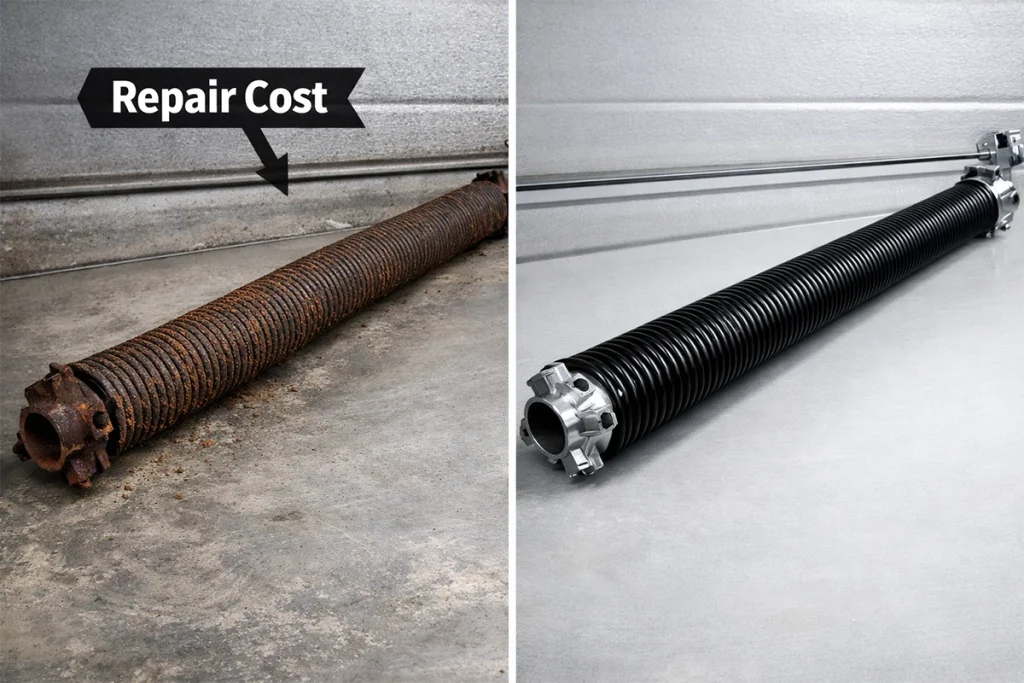
Mechanical Obsolescence : If your door relies on standard torsion springs that require replacement every 10,000 cycles, and your facility has ramped up throughput, you are paying a “friction tax.” Upgrading to a motor-driven high-speed system eliminates this recurring hardware cost.
The 50% Rule : If the estimated repair cost for a major collision or motor failure exceeds 50% of a new system’s value—especially when factoring in the increased U-value of modern ABX panels—replacement is the fiscally responsible choice.
Expert Tip: The Supremacy of U-Value over R-Value
Many facility leads are misled by material R-values. However, the U-value (thermal transmittance) of the entire door assembly—including perimeter seals and track integration—is what dictates your energy bill. When deciding to replace, prioritize ABX Doors that utilize broken cold bridge technology and dual-fin EPDM seals. An airtight seal is more critical to ROI than panel thickness alone.
Strategizing for a High-Throughput Future
A strategic entryway upgrade is an investment in supply chain resilience. High-speed automation reduces forklift wait times, prevents collisions through smart sensing, and maintains a hermetic seal for sensitive inventory.
By selecting ABX Doors, you leverage 15 years of engineering authority. Our industrial-grade hardware and IoT-integrated controllers provide the transparency and durability needed to optimize your long-term OpEx. Aligning your facility with modern standards ensures that your operation remains a leader in efficiency and security.
Request a technical datasheet or CAD specification from our engineering team today.