
Common Causes of Noisy Garage Doors and Engineering Solutions for Industrial ROI
In high-stakes cold chain logistics, thermal leakage is the single greatest invisible drain on facility profitability. While most managers focus on compressor efficiency, they often overlook the primary gateway of energy loss: the industrial door. For a noisy garage door, the sound of grinding metal or vibrating panels is more than a nuisance—it is a clear indicator of mechanical friction that slows down cycle times. In a temperature-controlled environment, every additional second of “open-air” exposure during a sluggish cycle leads to an energy hemorrhage that spikes OpEx.
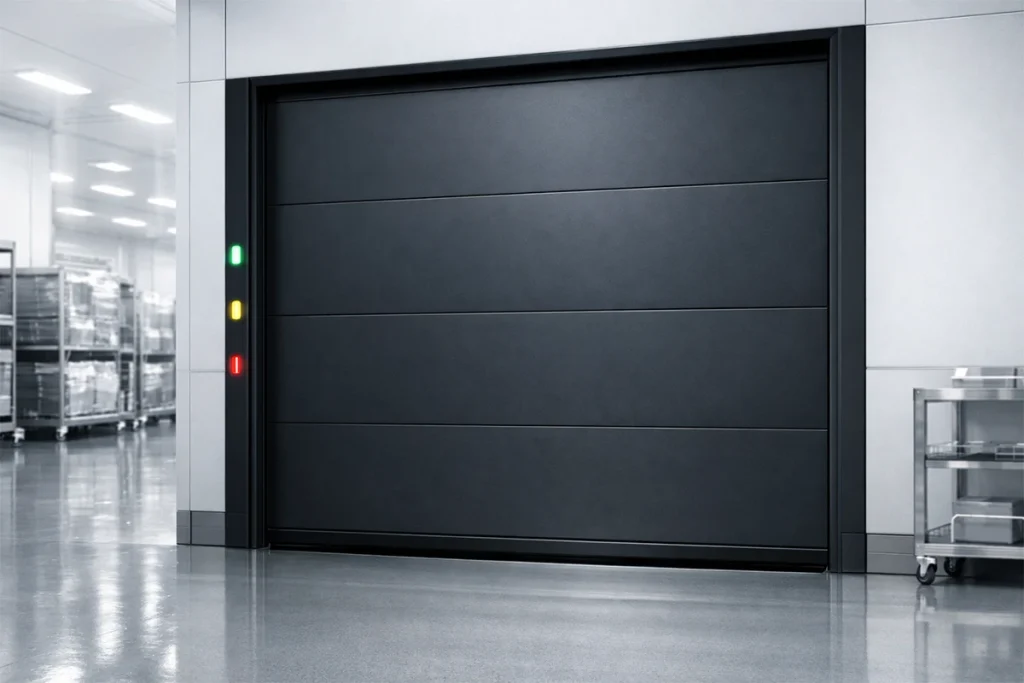
Diagnostic Analysis: Why Noise is a Warning Sign for Facility Managers
When an industrial door begins to emit rhythmic banging or high-pitched squealing, the facility’s structural security and thermal integrity are at risk.
Worn Roller Bearings
Standard rollers with dry bearings create intense friction. This friction forces the motor to work harder, increasing energy draw and slowing the door’s response time, which compromises the cold room’s climate control.
Torsion Spring Fatigue
A “chattering” spring indicates loss of tension. An unbalanced door places excessive stress on the drive system, leading to jerky movements that break the perimeter seal during closure.
Technical Comparison: High-Speed Precision vs. Standard Friction
The most effective way to eliminate noise and energy loss simultaneously is to transition from standard overhead systems to advanced high-speed automation.
Operational Performance Matrix
Performance Indicator | Standard Sectional Door | ABX High-Speed Spiral Door |
Noise Level | 65-80 dB (Friction-heavy) | < 60 dB (Precision operation) |
Opening Speed | 0.2 m/s (Sluggish) | 1.5 – 2.5 m/s (Rapid) |
Thermal Loss per Cycle | High (Extended air exchange) | Minimal (Instantaneous closure) |
Mechanical Wear | High (Standard hardware) | Low (Non-contact spiral track) |
Energy ROI | Negative (Energy leak) | Positive (Recoups cost via OpEx) |
Engineering the Fix: Precision Maintenance Protocols
If a complete system upgrade is not immediate, facility leads must implement a rigorous maintenance protocol to mitigate the “noise-to-energy-loss” pipeline.
Lubrication Science: Utilize industrial-grade synthetic lubricants specifically for high-cycle torsion springs and roller raceways. Avoid standard grease, which attracts warehouse dust and creates an abrasive grinding paste.
Fastener Calibration: Vibrational noise often stems from loose hinges or track brackets. Ensuring every bolt is torqued to specification prevents the “micro-gaps” that allow cold air to escape.
Expert Tip: The Supremacy of U-Value Sealing
A door can be whisper-quiet but still a financial disaster if its U-value (thermal transmittance) is unoptimized. Noise often indicates that the door is not seating correctly against the EPDM perimeter seals. Always prioritize airtightness and low U-values over simple R-values. If you can hear air whistling through the seals, you are hearing your facility’s ROI evaporate.
Strategizing for a Silent and Efficient Future
Selecting a door system for a modern logistics hub is a strategic investment in reliability. High-speed spiral doors and insulated sectional doors from ABX Doors are engineered to eliminate the mechanical friction that causes noise, ensuring a seamless thermal barrier. By reducing opening times and maximizing structural rigidity, we help businesses achieve an uncompromised thermal envelope and a superior bottom line.
Request a technical datasheet or CAD specification from our engineering team today.