
High-Speed Spiral Doors: Revolutionizing Logistics Efficiency and Energy ROI
Thermal leakage at loading docks represents the single greatest invisible cost in cold chain logistics. For facility managers, every second an entryway remains open—or every cycle delayed by a standard sectional door—is a direct hit to the company’s bottom line. In high-frequency environments, “Energy Hemorrhage” caused by slow door operation can increase refrigeration loads by over 40%. High-speed spiral doors provide the definitive engineering response, merging rapid-action automation with industrial-grade insulation to secure the facility’s thermal envelope and streamline operational throughput.
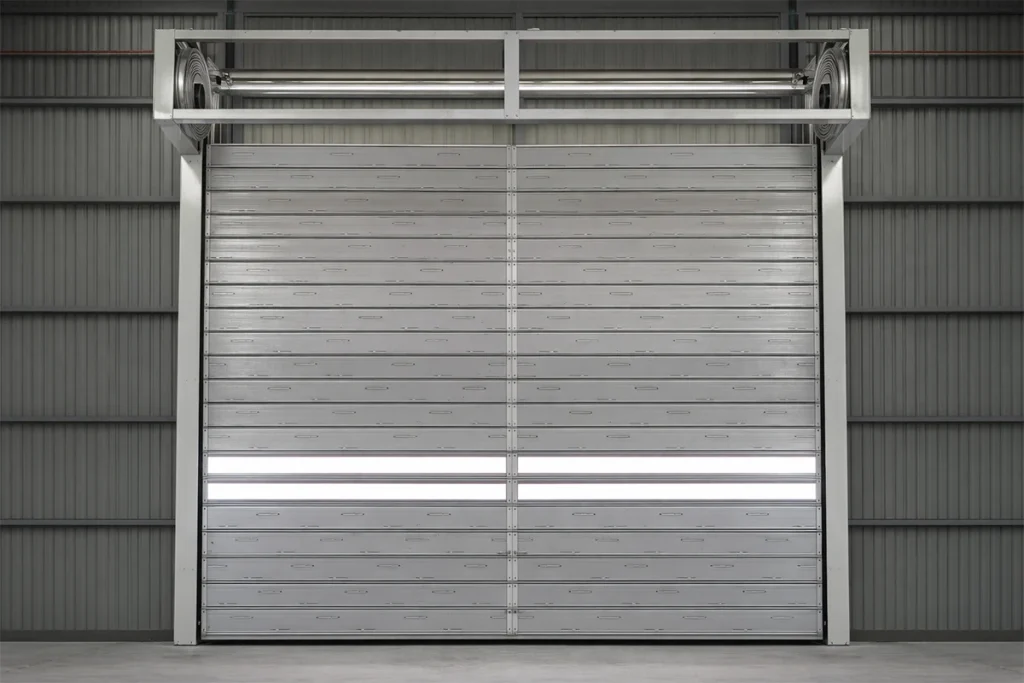
Frictionless Spiral Technology: Maximizing Throughput Velocity
The primary revolutionary aspect of a high-speed spiral door is its circular, non-contact guide rail. Unlike standard overhead doors where panels slide against one another, the spiral design ensures that the door segments never touch during the opening and closing phases.
Zero-Friction Operation
The segments are guided into a neat roll at the header without contact, eliminating surface scratches and mechanical noise.
Throughput Acceleration
With opening speeds reaching up to 2.5m/s, ABX spiral doors allow forklifts to maintain momentum, drastically reducing the bottlenecks that plague high-volume distribution centers.
Thermal Integrity: Engineering the Energy-Saving Barrier
Selecting an entryway for a temperature-controlled facility requires a focus on material science. The table below illustrates the performance gap between traditional sectional doors and modern high-speed spiral solutions.
Industrial Door Efficiency Comparison
Feature | Standard Sectional Door | High-Speed Spiral Door |
Cycle Speed | 0.2 m/s | 1.5 – 2.5 m/s |
Open Time per Cycle | 30 – 45 Seconds | 5 – 8 Seconds |
Thermal Loss per Cycle | High (Massive air exchange) | Minimal (Rapid closure) |
Panel Material | Standard PU Steel | High-Density PU (R-13.5+) |
Mechanical Life | 15,000 – 30,000 Cycles | 250,000+ Cycles (Heavy-duty) |
Expert Tip: The Sealing Power of the U-Value
In professional logistics engineering, the R-value of the panel only tells half the story. The U-value (thermal transmittance) of the entire door system—specifically the airtightness of the perimeter seals—is what dictates your energy bill. Ensure your high-speed door utilizes broken cold bridge technology and dual-fin EPDM seals to prevent “air bypass,” which is the leading cause of evaporator frost in cold chain facilities.
Structural Security: Protection Beyond Speed
Facility managers often struggle with the choice between a fabric fast door (for speed) and a sectional door (for security). High-speed spiral doors eliminate this dilemma by using 40mm to 50mm double-walled aluminum panels.
Forced Entry Resistance : The rigid aluminum slats provide a formidable barrier against unauthorized access, essential for 24/7 autonomous facilities.
Wind Load Capacity : The interlocking slat design and heavy-duty side tracks allow the door to withstand significant external wind pressure, maintaining a secure seal even in coastal storm conditions.
Operational ROI: Lowering Long-Term OpEx
While the initial investment in spiral technology may be higher than standard systems, the Total Cost of Ownership (TCO) is significantly lower.
Low Maintenance Design: The non-contact spiral track minimizes mechanical fatigue. ABX high-speed systems are engineered for high-cycle environments, requiring far fewer service interventions than traditional spring-balanced doors.
Energy Payback: In a typical 24/7 cold storage hub, the energy savings alone can recoup the price difference within 18 to 24 months of installation.
Strategizing the Future of Warehouse Access
Modern facility design is a science of efficiency. Aligning your infrastructure with high-speed spiral doors from ABX Doors represents the most direct path to mastering your thermal envelope while maximizing logistics throughput. By prioritizing speed, structural rigidity, and low U-values, you transform an entryway from a liability into a high-performance industrial asset.
Request a technical datasheet or CAD specification from our engineering team today.