
Polyurethane vs. Polystyrene: Comparing Insulation Materials for Industrial Doors
Thermal leakage in cold chain logistics is a silent profit killer. For facility managers operating large-scale warehouses, every entry point represents a potential “energy hemorrhage” where expensive treated air escapes into the ambient environment. In high-stakes temperature-controlled sectors, the primary defense is the door’s insulation core. The choice between Polyurethane (PU) and Polystyrene (EPS) determines not only the facility’s R-value but also its long-term structural resilience and operational OpEx.
The Science of Thermal Resistance: R-Value Performance
The efficiency of insulation materials for industrial doors is quantified by their R-value—a measure of thermal resistance. While both materials provide insulation, their molecular density creates a significant performance gap.
Polyurethane (PU) Superiority
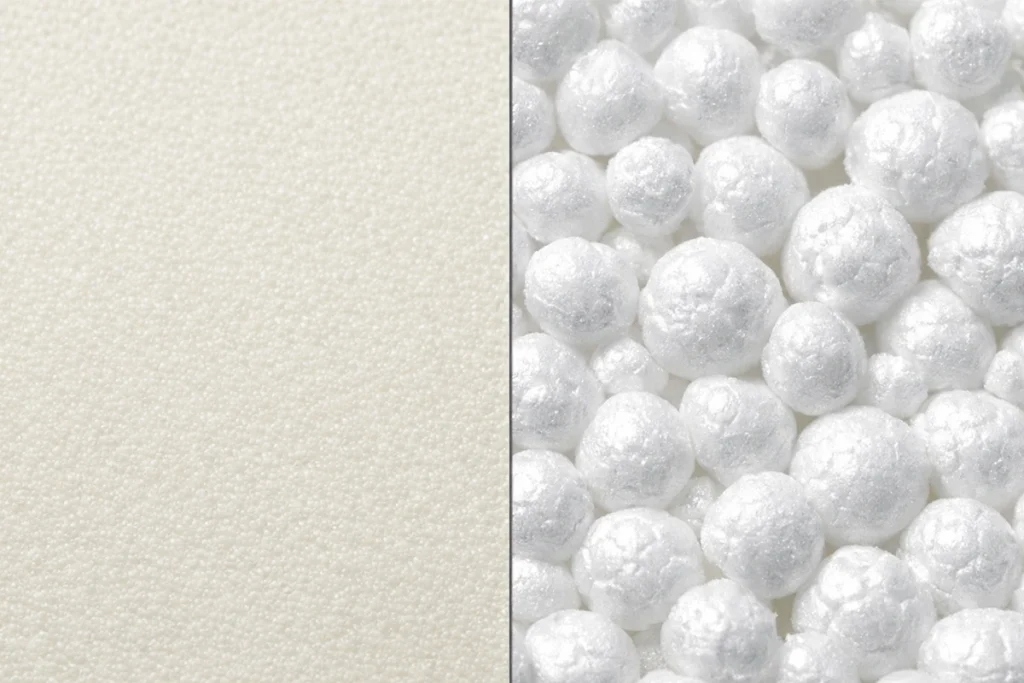
ABX utilizes a six-component pentane foaming process to inject liquid PU between steel skins. As it expands, it fills every micro-cavity, achieving an R-value nearly twice that of Polystyrene for the same thickness.
Polystyrene (EPS) Limitations
EPS is a pre-formed rigid board that is glued into the panels. This method inherently leaves small air gaps between the insulation and the steel skin, leading to lower thermal efficiency and potential cold spots.
Structural Integrity: Core Density and Panel Rigidity
In high-traffic commercial environments, the door panel must withstand wind pressure and mechanical stress without delaminating.
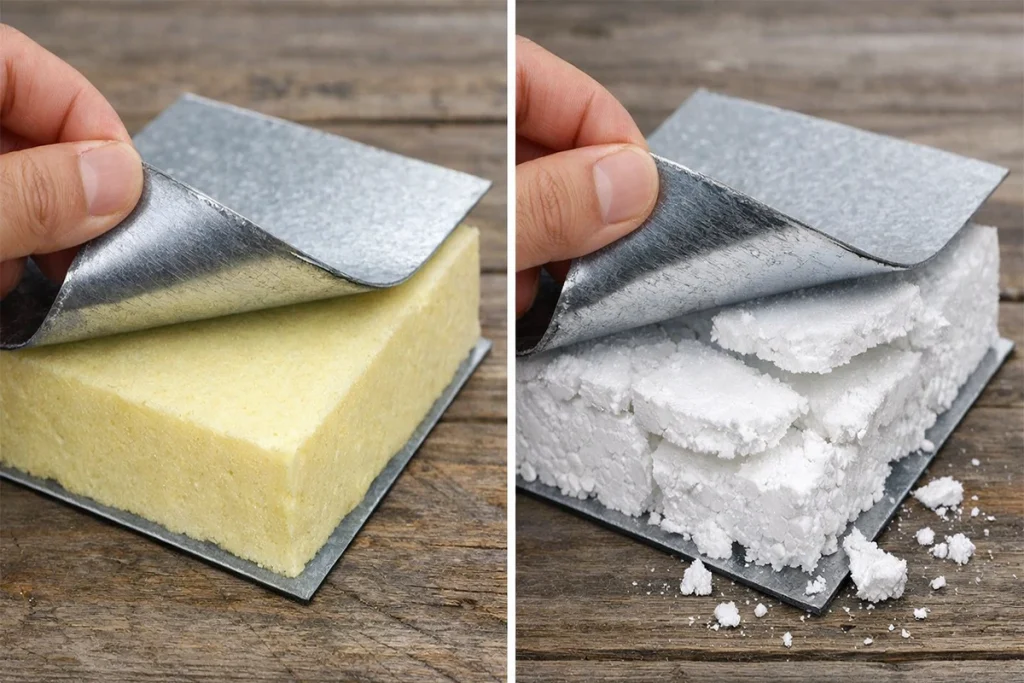
Impact Resistance: High-density PU foam creates a chemical bond with the steel surfaces, transforming the panel into a rigid monolithic structure. This ensures that PU foam sandwich panels remain intact even under high-cycle operation.
Aging and Sagging: Over time, the adhesive used in EPS doors can degrade, causing the insulation board to sag or detach. This not only destroys the thermal barrier but also imbalances the door’s weight, leading to motor strain.
Operational Comparison: ROI and Throughput
Selecting the core material is only half the equation; the door’s operation type dictates the final energy ROI. The table below compares standard configurations with advanced high-speed systems.
Performance Matrix: Material & System Efficiency
Feature | Standard EPS Door | ABX High-Speed PU Door |
Insulation Core | 5 – 7 Years | 1.5 – 3 Years |
Thermal Barrier | Moderate (R-10 to R-12) | High (R-18 to R-24) |
Opening Speed | High (Leaks at seals) | Ultra-Low (Airtight) |
Energy ROI | Significant (0.3 cfm/ft²) | Minimal (0.05 cfm/ft²) |
Ideal For | Low-traffic ambient | Cold Storage / High-traffic |
Expert Tip: The Criticality of U-Value Over R-Value
In professional facility engineering, don’t be blinded by the material’s R-value. The U-value (thermal transmittance) of the entire installed system is the true metric. A PU door with poor EPDM perimeter seals will still leak energy. Always specify high-density cores combined with full-perimeter airtight seals to achieve the lowest possible U-value.
Strategizing for Long-Term OpEx Reduction
While Polystyrene doors may offer a lower upfront acquisition cost, the “hidden” energy costs quickly bridge the gap. For a 24/7 cold chain warehouse, the energy savings from a Polyurethane industrial door typically recoup the price difference within the first 18 months of operation.
By prioritizing material science and advanced automation, facility managers secure a durable, energy-efficient infrastructure that protects both products and profit margins.
Request a technical datasheet or CAD specification from our engineering team today.